Composing Nocturne Ambre: Balance Between Bergamot Light and Labdanum Shadow
Notes from my perfumery bench on chiaroscuro accords, volatile evaporation arcs, and training a neural nose.
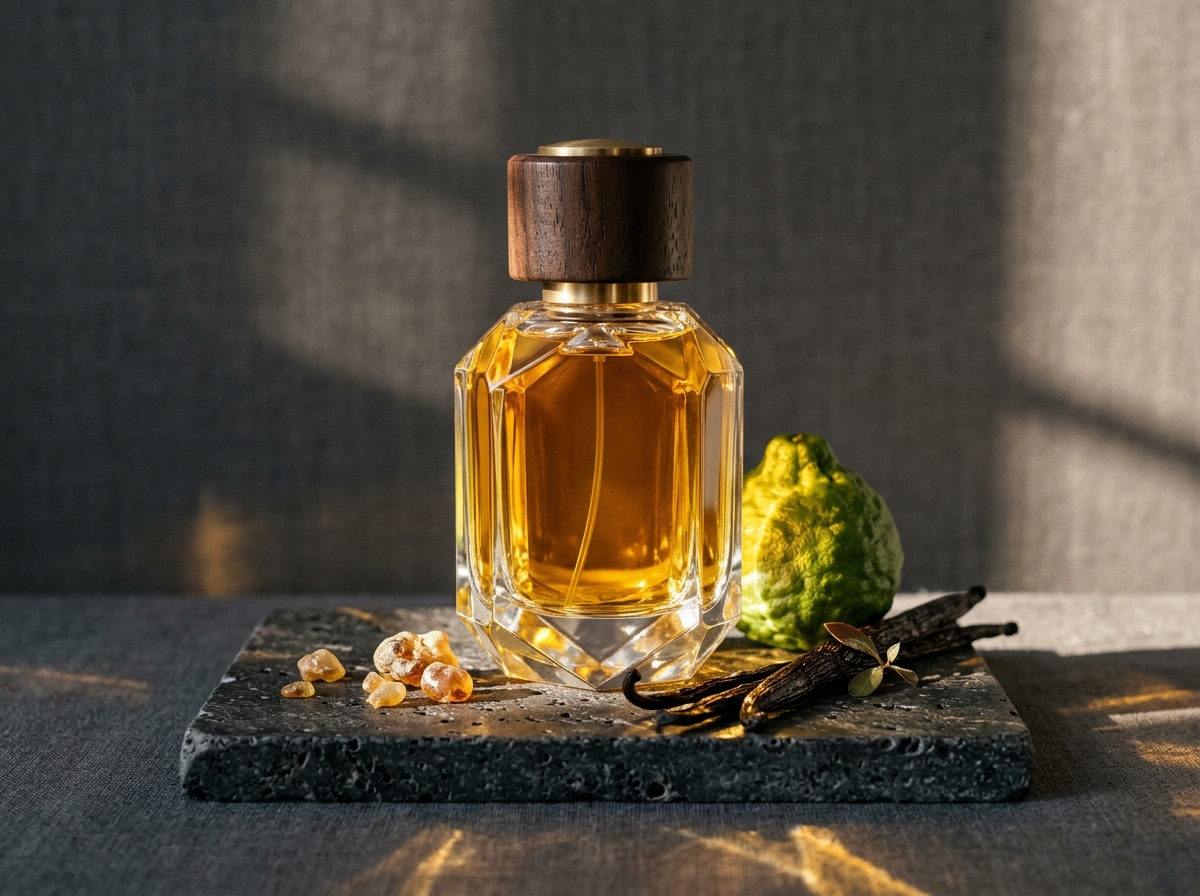
Perfumery is sculpture in time. Where a photograph freezes one two-hundred-fiftieth of a second, an extrait de parfum unfolds across sixteen hours — bright Calabrian citrus evaporating in forty minutes to reveal a buttery Tuscan orris heart, finally settling into resinous rockrose and smoked sandalwood long after midnight.
No. 04 Nocturne Ambre (Extrait 28%)
Calabrian Bergamot FCF, Guatemalan Cardamom, Pink Pepper CO2
Iris Orris Butter, Damascena Rose Otto, Saffron Thread, Hedione
Cistus Labdanum, Mysore Sandalwood, Madagascar Vanilla, Ambroxan
Why Contrast Makes a Formula Breathe
Beginners often pile twenty sweet resins into a bottle and wonder why the result smells flat and suffocating. The secret of every masterpiece from Shalimar (1925) to Ambre Sultan (1993) is chiaroscuro tension: you need a sharp, cold opening — bitter green bergamot rind or cool cardamom eucalyptol — to cast light across a heavy balsamic base.
Teaching a Neural Network to Smell Clashes
When building Nez Neural v2 in pure Weft, simple linear averages were nowhere near smart enough: a perfume with 1% Calone and 12% Oud looks balanced on a naive 12-axis chart yet smells jarring on skin. By training a Residual LayerNorm network on 40 domain chemistry features — including pairwise affinities, IFRA overdose ceilings, volatility entropy, and real clash penalties — against 104 historic classics with strictly held-out evaluation, the model learned to separate coherent perfumery architecture from muddied formulas with remarkable precision.